

Big Bear Lake, California

FEATURING:
* The Planetarium Projector Hall of Fame *
From the Golden Age of Planetarium Projectors
Starring An Astronomical Collection of Antique
Planetarium
Projector Instruments from Theaters of the Stars!
"Preserving our Planetarium Past for our Future
to the Benefit of All Planetariums Everywhere"
A place to come and study the history, design, contruction and evolution of Planetarium Projectors.
Where preservation, display, and education about our historic and rare Planetarium Projectors is our only mission.
We collect worn out Planetarium Projectors for Display and Preservation.
"The most valuable acquistion of the Planetarium Projector Museum is the enthusiasm it invites: Inspirational Today / Legendary Tomorrow"
Owen Phairis III: Director & Curator (909-806-5698)
Ron Walker: Director of Engineering and Historian
Gary Likert: Director and Advisor on Home Planetariums
Steve T. Cole: Director of Scientific Displays and Exhibits
J.R. and Owen Phairis IV: Trustees and Directors of Logistics
Working on an Educational and Entertaining Planetarium Museum Exhibit!
We will be making the Planetarium Projector Collection Available as a Traveling Science Exhibit to Planetariums and Museums across the Country!
UPDATE: We are currently seeking Museums to display the exhibit and sponsors to help us in the preparation and also the transportation of the scientific planetarium instruments for exhibition.
(click for an open letter)
Museums' Goto Apollo Eros Planetarium Projector
This is the Museums latest acquistion with arrival expected December 2008. This projector comes from Mr. Jon Elvert and is one of about 300 made. This brings the total number of planetarium projectors in the Museum collection to 12.

Museums' Spitz STP Planetarium Projector
This magnificent projector is one of only 12 ever made by Spitz. This projector was purchased from The Gengras Planetarium at The Children's Museum in Connecticut and is affectionately known by the name of Stella. She completed nearly 40 years of continuous service and educated over 1,000,000 people before being replaced by an all new digital planetarium system. She is capable of generating over 4,000 stars and all the visible planets. This machine is currently at the Museum and is undergoing restoration for display. Here is a list of the 12 STPs that were built and where they originally went to: Houston, Trenton, Salt Lake City, Abrahms at Michigan State, Bradenton's Bishop Planetarium, Yonkers, Denver, Hartford, Warminster, "Saint" Disco in NYC, and two are still in service giving planetarium shows at Montgomery and Miami.

Stella our Spitz STP Projector being Restored
Some interesting facts about the STP projector. It was the first commercial projector to have a third (yaw) axis and the very first to be computer controlled. It projects over 4,000 stars to magnitude +5.8 and all stars greater than 3.5 are projected using 260 separate lenses. It uses two 75 watt arc lamps for light sources for projection on a 40 to 65 foot dome. There are 10 analogs versus 7 as in the popular A3P. There is a separate analog for the Earth which was needed because this was the very first projector that would allow you to place the audience on the moon or other location in outer space. There are also two analogs for the sun (mean and true) which makes demonstrating the equation of time not only possible but also easier to visualize.


Photograph of Stella and our Planetarium Collection
Some more interesting facts about the STP projector. Each instrument requires 43 motors, over 12 miles of electrical wiring and more than 6,000 electrical connections. Total package price installed was around $ 146,575.00 with a 40 foot dome way back in 1963. This projector also has zooming earth and zooming moon projectors installed so during a planetarium program they could take visitors on a space flight and safely return.

Museums' Spitz A-1 Planetarium ProjectorThis projector may have been used at the University of Michigian. This one is Serial Number #131 and Code # A1 300. It is one of about only 40 ever made before they started making the A2 and I beleve this one was built in 1953.

Closeup Spitz A-1 Planetarium Projector
Pictured accessories include the astronomical triangle used for teaching celestial navigation on the left. Also to the left is the geo-centric earth projector. In the back, barely visible, is the meridian projector and also the twilight projector. The co-ordinate projector is on the far right and the planet projectors between it and the dodecahedron star globe.

Museums' GOTO S-2 Planetarium ProjectorShown here is the Museums very first projector, purchased from a private party and built in 1959. This is a fully optical projector using 32 lenses to project the stars on a 24.6 foot dome. This projector projects about 2500 stars and all the visible planets and moon phases.

Closeup Photograph of the GOTO S-2

Museums' GOTO Mercury Planetarium ProjectorThis historic and rare projector came from Holt Planetarium located at the Lawrence Hall of Science, UC Berkeley. The projector was built in 1965 and displays around 1800 stars. Originally it was sold to UCLA for around eight thousand dollars. In 1973 it moved to UC Berkeley where it operated until February 29th 2008 where it entertained and educated over 500,000 people before being retired. After a 35 year absence it has now been returned to Southern California and moved to the museum for display and occasional use.

Another shot of the GOTO Mercury Planetarium Projector

Museums' Goto Venus Planetarium Projector
The Planetarium Projector Museum is very proud to accept the donation of an early 1970s Goto Venus planetarium projector. The projector came from the Christa McAuliffe Planetarium which is part of the Pueblo Colorado City School District. Arrival date at the Museum was September 17th, 2008. The projector is currently undergoing reconstruction at the Museum and more pictures may be found on the Planetarium Picture Scrap Book pages of this website.
Goto Venus Planetarium Projector at the Museum
Closeup pictures of the Venus Planetarium Projector
The Goto Venus Planetarium Projector originally cost $ 10,350.00 back in 1963 FOB Yokohama, Japan. It was designed for a 24.6 foot dome and generates 3,200 stars down to magnitude of 5.8. It has horizon cutoffs and a gross weight of aproximately 800 pounds. The construction of this projector was inspired by the original American designed Academy projector at the Morrison Planetarium in San Francisco California. Even though the Venus is much smaller in size than the Academy projector, measuring only 69 inches from planet cage tip to tip it is a very powerful and interesting planetarium instrument.

Museums' Minolta Series II B Planetarium Projector
The Planetarium Projector Museum is indeed fortunate and very proud to receive the donation of a Viewlex Minolta Series II B planetarium projector. This projector is a generous donation to the Museum from the Robert J. Novins Planetarium located in Toms River New Jersey.

Museums' Minolta Projector & Console
This 1974 vintage planetarium projector originally cost $ 110,000.00 and is capable of optically generating over 4,000 stars on a 40 foot dome. The projector arrived at the Museum in late August 2008 and we just completed her restoration. Pictures of the restoration process on this marvelous projector have been posted on the Planetarium Picture Scrap Book pages of this website.

Minolta Projector after Restoration at the Museum

Museums' Spitz A3P Planetarium Projector
This projector was originally sold to and used in the Tessman Planetarium at Santa Anna College, California. The A3P instrument was sold mostly to colleges and schools in the 1960s and 70s. This one has a Spitz serial number of 3275. The A3P is one of the most common of all the commercial planetarium projectors ever made. It projects about 1500 stars and uses both pinholes and also lens projection for the brighter stars and was designed for a 24 to 40 foot dome. We believe there were about 500 model A3P/A4 types produced by Spitz when it was mostly replaced by the model 512/1024 in 1973.

Museums' Spitz A3P and Nova Projectors

Museums' Nova III Planetarium Projector
This came to the Museum from a high school in Kentucky which was the main market for this type of projector. This projector was released in 1963 and originally sold for two thousand dollars. It was built by the Harmonic Reed Company and later by Spitz in 1971. We believe there were about 300 made and it projects about 500 stars.

Museums' Spitz-NASA Apollo Program ProjectorThis one of a kind projector was built by Spitz under contract from NASA for the Apollo Space Program. The projector was computer controlled to recreate space craft movements in space and to simulate a trip to the moon. The projector was sent to MIT which in turn made the navigation computer for the Apollo Project. After the Apollo Program ended it was sent to Boston University where it served as their planetarium projector for 20 years. The projector is capable of projecting close to 3,000 stars and has a 24 inch starball which may be the largest pinhole starball ever made. This also served as the prototype for the Spitz STS planetarium projector. Due to the historical significance of this planetarium projector the museum is indeed fortunate to be able to purchase it and would like to thank Steve Pielock for the background information and also his help in obtaining it.

Museums' Emmons HPA Planetarium ProjectorThis one of a kind projector has been donated to the museum from the Home Planetarium Association and Mr. Gary Likert. The projector was built in 1995 and features the second to the last Emmons starball ever produced. This projector will provide inspiration and serves as an excellent example of what can be done in the home by talented individuals. This projector is currently undergoing reconstruction and we hope to have new pictures soon. This machine will then proudly take its place along side the commercial planetarium projectors and take its place in history as well.

Museums' Emmons HPA Projector as it appears today 10/12/2008

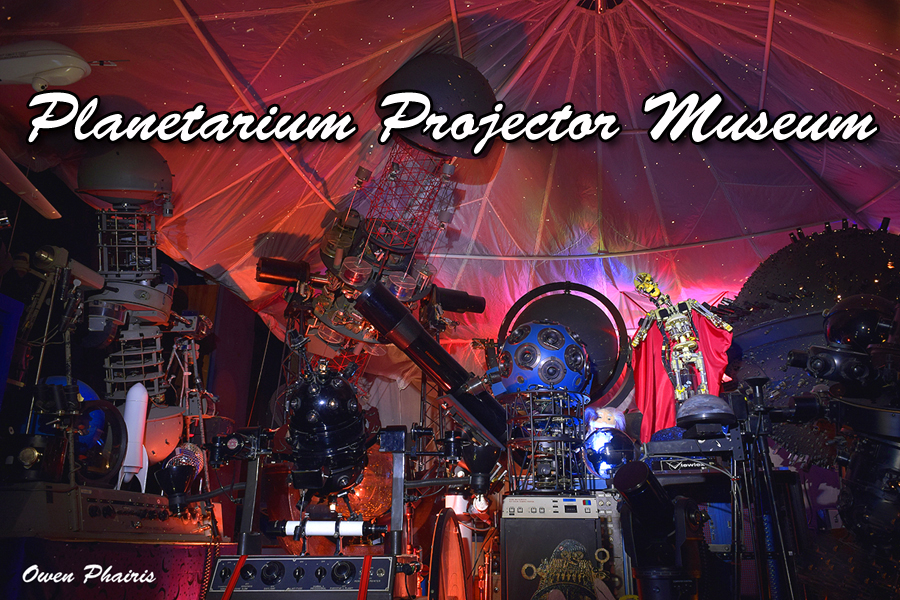
Museums' Planetarium Projector Collection


Spring and Summer ads placed in: "The Great Western Observer"There are also articles on pages 16 and 31 about the Museum.
Index of issues may be found here: "Great Western Observer Index"Museums Fall ad and future Winter ad for GWO are below:

PLANETARIUMS GONE WILDShort 60 Second Video ClipDemonstration of the movements of the Goto S-2 and Mercury Projectors.


The Growing Collection of Planetarium Projectors
A 3-D Stereo Photograph
Crossed eyed viewing - Look at left image with right eye and right image with left eye.
A third 3-D color stereo image will form in center.
A 3-D Stereo Photograph
This 3-D anaglyph image requires standard Red (left eye) / Blue (right eye) 3-D glasses.
More exciting 3-D projector images can be found here:
3-D Stereo Planetarium Projectors
MUSEUM EXHIBTS MAY INCLUDE:
- Spitz A-1 Planetarium Projector
- Spitz A3P Planetarium Projector
- Spitz A3P Planetarium Projector Operator Console
- Spitz STP Planetarium Projector and Relay Racks
- Spitz STS Prototype Planetarium Projector
- GOTO S-2 Planetarium Projector
- GOTO Mercury Planetarium Projector
- GOTO Venus Planetarium Projector
- GOTO Apollo Eros Planetarium Projector
- GOTO M-1 Planetarium Projector Star Globes
- Minolta Series II B Planetarium Projector
- Minolta Series II B Planetarium Projector Operator Console
- Nova III Planetarium Projector
- Homemade Emmons-HPA Planetarium Projector
- Conic Copernican Helio-Centric Projection Orrery
- Spitz Copernican Helio-Centric Projection Orrery
- 4 inch f-15 Unitron Refractor Telescope
- 6 inch f-10 Vernon Refractor Telescope
- 6 inch f-6 Celestron Refractor Telescope
- 8 inch f-10 Meade SCT Telescope
- 8 inch f-6 Meade Newtonian Telescope
- 8 inch Homemade Heliostat
- 90mm f-10 Meade ETX Maksutov Telescope
- 138 pound Museum Quality Meteorite
Member: Pacific Planetarium Association
Member: Bear Valley Astronomical Association
Member: Rocky Mountain Planetarium Association
View my page on The Planetarium Network
INTERESTED in Planetarium History?
Check out these links:
INTERESTED in building your own Planetarium?
Check out these links:
Please click on the picture scrapbook link below for the latest updates as well as many more interesting
photographs. We believe that most all photographs on this site are copyright free and may be copied and used freely to advance interest in Science, Engineering, Astronomy and Planetariums everywhere. Please check with us to verify before publication and for credit information. In many cases higher resolution images may be available.
Please call Owen at 909-584-8551 for more information or at: ophairis[at]hotmail.com.


Have a Planetarium Projector to Donate or Sell Us?